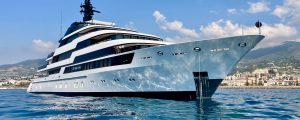
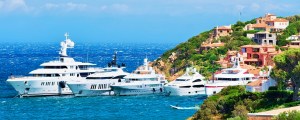
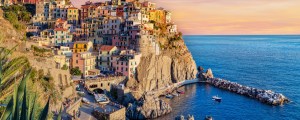
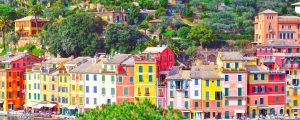
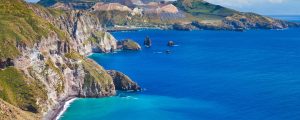
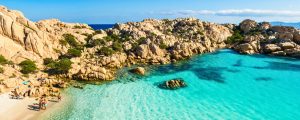
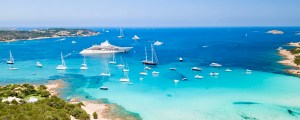
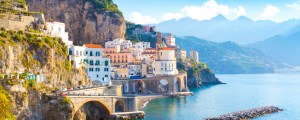
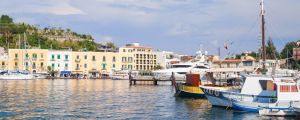
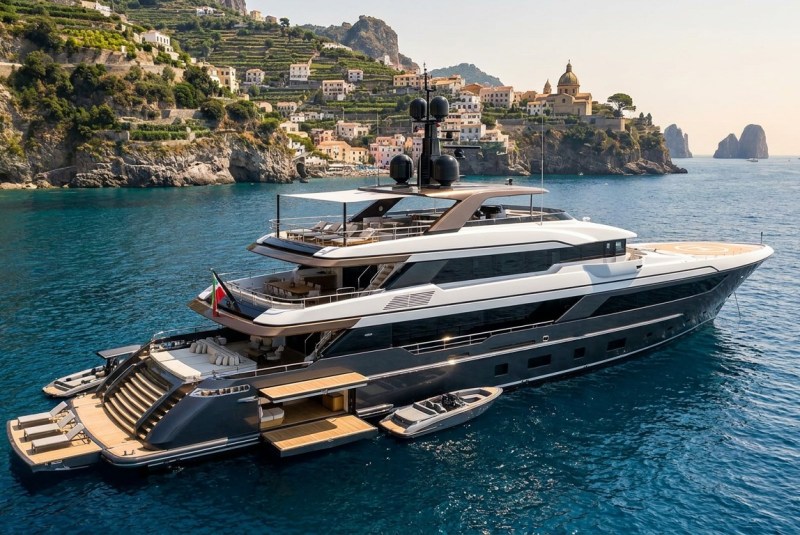
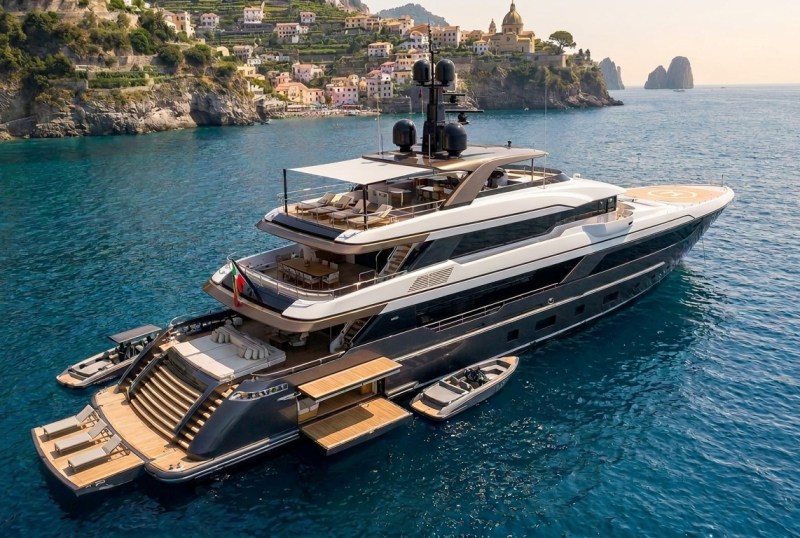
“Capri is the glamour stop of the Italian coast: the Faraglioni, the Piazzetta and an anchorage full of superyachts, with the better half of the island reachable only from the water.”
In short. Capri sits at the mouth of the Gulf of Naples, 17 nautical miles from Naples and 7 from Sorrento. Yachts berth in Marina Grande or anchor off Marina Piccola and tender in. A week on this coast starts near €80,000.
This is the stop clients name before they have chosen a yacht. Capri has been a status address since Tiberius built his palace on the eastern headland, it gave the world the Capri sandal and Jackie Kennedy’s version of an Italian summer, and in July and August the water off Marina Piccola fills with superyachts.
It is also, from the shore, one of the busiest islands in Italy. Capri has two towns on top of it and almost no shoreline you can walk to. That is the whole case for seeing it from a yacht.
On a Capri yacht charter you arrive before the hydrofoils, swim under the Faraglioni where there is no path down, and lap the cliffs and the caves on your own. You are back on board with a drink when the last day boat leaves for Sorrento. It suits a group that wants one glamorous day and one quiet one, in the same place.
It sits 17 nautical miles from Naples and 7 from Sorrento, which makes it a stop on nearly any Amalfi Coast week rather than a destination you commit the whole charter to. Our seven-day Naples round trip reaches it on day three, after Procida and Ischia, and leaves for Nerano the next morning.
Must-dos on Capri
- A swim under the Faraglioni, then the tender through the arch in the middle stack
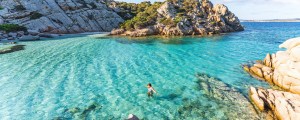
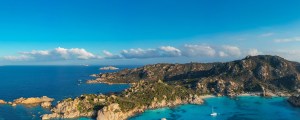
- A private lap of the island, the cliffs, the caves and water with nobody in it
- The Blue Grotto early, attempted the moment conditions allow rather than promised
- Monte Solaro by chairlift, twelve minutes up to 589 metres and the whole bay below
- Dinner under the lemon trees at Da Paolino, or lunch at Il Riccio above the grotto
On this page: a day on Capri · Marina Grande and the town · the Faraglioni and the south side · Anacapri and the Blue Grotto · where yachts tie up · what it costs · distances · when to go · day charter or the week
What a day on Capri actually looks like


This is the shape our brokers plan, and the order matters more here than anywhere else on the coast.
Early. Up and moving by eight. If the Blue Grotto is going to happen, it happens now, before the boats from Sorrento arrive and before the swell builds. The crew calls it on the morning, not the week before.
Mid-morning. Round the island. Turning west out of Marina Grande you pass the Blue Grotto, round the Punta Carena lighthouse at the south-west tip, and come up the south coast past the Green and White Grottoes to the Faraglioni.
It is about nine nautical miles, a comfortable morning with swim stops in it, and the part a day boat has no time for. Stop where the water looks right.
Lunch. Either on board at anchor off Marina Piccola with the Faraglioni off the stern, or ashore at a beach club under them. La Fontelina and Da Luigi both need booking, and both want committing to.
Afternoon. Tender in and go up. The Gardens of Augustus are a five-minute walk from the Piazzetta and give you Via Krupp and the Faraglioni in one frame; Anacapri and Villa San Michele are the calmer half of the island.
Evening. This is where a yacht wins. The day-trip crowd leaves on the last ferries, the Piazzetta empties out, and the island becomes a small Italian town for a few hours. Dinner ashore, then back aboard; or stay at anchor and watch the lights come on under Monte Solaro.
What our brokers and captains say about Capri
Capri is the one stop on this coast where the brief and the reality can part company. This is what the people who run it actually say.
One of the Italian captains we filmed put the whole page in two sentences: Capri is nothing if you stay on Capri, but if you are on a boat looking at Capri, it is completely different.
Our own planning notes, honed over a lot of Amalfi weeks: the Blue Grotto is an attempt, not a booking. The beach clubs are reservation-sensitive and want a decided plan rather than a mood.
Villa Jovis is worth doing and should never be forced into a beach-club day. And a private lap of the island becomes, for many of our clients, the favourite part of Capri, more than the town.
Marina Grande, the Piazzetta and Capri Town: the north side
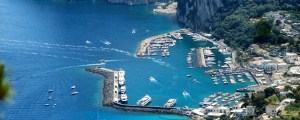
Marina Grande is the port, on the north side facing the Gulf of Naples, and where everything arrives: ferries, hydrofoils, tenders and the yachts that have a berth.
The basin holds around 300 berths and depth runs roughly 2 to 8 metres. The approach is from the north, and ferry traffic has priority over everything, so the last few hundred metres are busy water.
From the quay the funicular goes up to Capri Town and the Piazzetta, the small square the island organises itself around, with the designer shopping in the lanes behind it.
Capri Town is the half of the island with the noise and the names. Da Paolino serves dinner under a canopy of lemon trees and is the meal guests describe to other people.
The Gardens of Augustus are the viewpoint with the highest return for the least effort, five minutes from the square, looking down on Via Krupp’s switchbacks and across to the Faraglioni. Villa Jovis, Tiberius’ palace on the eastern headland, is a proper walk and a proper Roman site for the group that wants one.
Marina Piccola, the Faraglioni and the beach clubs: the south side


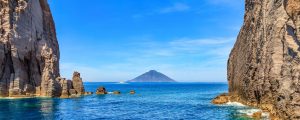
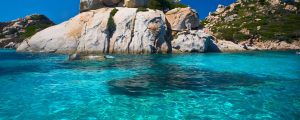
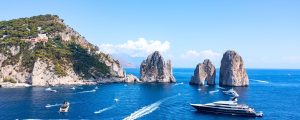
The Faraglioni are the three limestone stacks off the south-east corner, and the middle one has an arch through it that a tender can pass. Swimming here, with the stacks above you, is the Capri photograph everyone already has in their head, and from a yacht it costs nothing but the time to get round the corner.
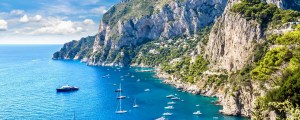
Marina Piccola, the bay on the south side, is where our crews anchor and tender in. It is the shelter from the northerlies, it is beautiful, and it is where Greek myth put the sirens that sang at Odysseus.
Southerlies make it uncomfortable, and the other bays round the island are rocky and poorly sheltered, which is why they are day stops and not nights.
Above the bay, La Fontelina and Da Luigi ai Faraglioni are the two beach clubs with the Faraglioni as the backdrop: sunbeds, lunch and a booking made well in advance.
Anacapri, Monte Solaro and the Blue Grotto: the high half

Anacapri is the other town, higher up the island and a different temperature altogether: fewer shops, more air, and the walk to Villa San Michele, the villa and cliff-edge gardens the Swedish doctor Axel Munthe built. It is a good reset after a morning in the crowd.
From the village square the single-seat chairlift runs to the top of Monte Solaro, 589 metres, in a little over ten minutes; the path up takes about an hour. The Hermitage of Santa Maria a Cetrella, built around 1400, sits just below the summit.
The Blue Grotto is on this coast, below Anacapri. The visit is by small rowboat through an entrance barely a metre high, which is why it closes with any swell and queues on a calm August morning.
Our line to clients is to treat it as an attempt early in the day: make the cave a stop, not the whole plan. Il Riccio, just above it, is the seafood lunch that pairs with a grotto morning and our go-to for fine dining on the island.
Where yachts actually tie up at Capri
- A berth in Marina Grande is the easiest night on Capri and one of the most competitive marina stops in Italy. Our own advice, from our guide to marina and anchor nights, is that if a Capri marina night matters it has to be discussed early, not decided on the evening. Prices here run high, especially in peak season.
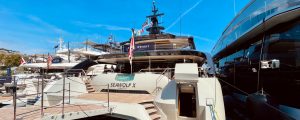
- At anchor off Marina Piccola with tender access ashore is how many yachts do Capri, and it works well in settled weather. You get the island without sleeping in the busiest part of the port.
- A day call only is the common answer for a larger yacht: arrive early, do the island, and move to Ischia or Nerano for a quieter night at anchor.
Capri is a small, rocky island with two usable bays and a port that works for ferries first. None of that is a reason to skip it. It is the reason the plan is made before you board rather than on the day.
Two calls are your captain’s, not yours. Italy protects its Posidonia seagrass meadows, and an anchor tears out in seconds what takes decades to grow back, so the crew picks sand and will refuse a bay that looks perfect from the rail. And tender traffic here in August is heavy enough that the pick-up point is planned as carefully as the drop-off.
What a week around Capri costs
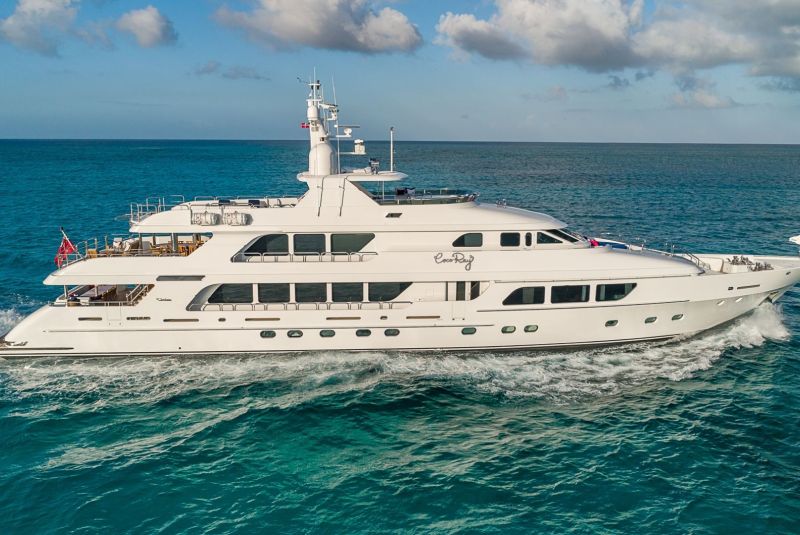
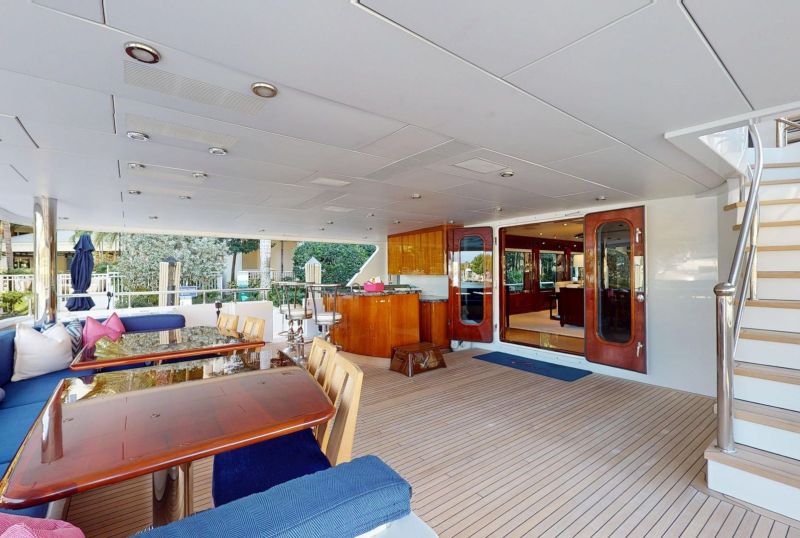
A crewed week in this part of Italy starts around €80,000 for a motor yacht. Most of the Amalfi and Capri weeks we book land between €150,000 and €300,000, and the top of the market runs €300,000 to €500,000 and above.
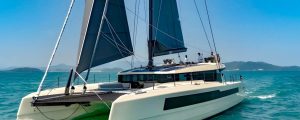
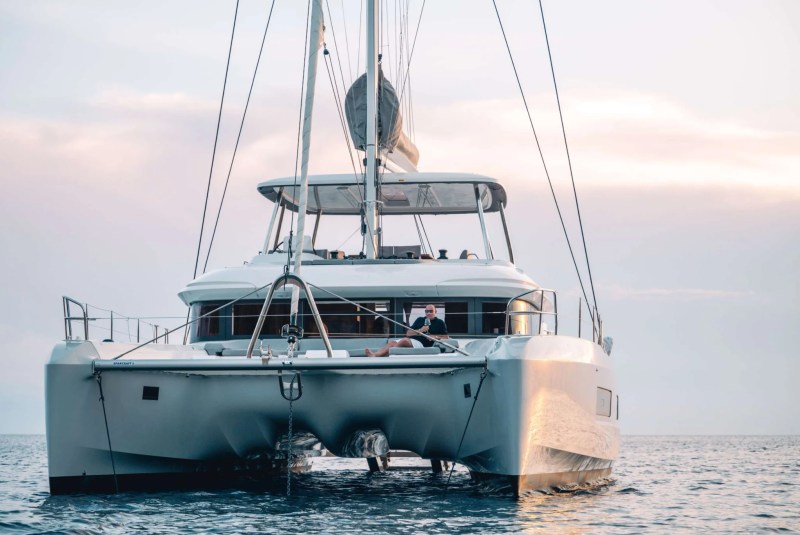
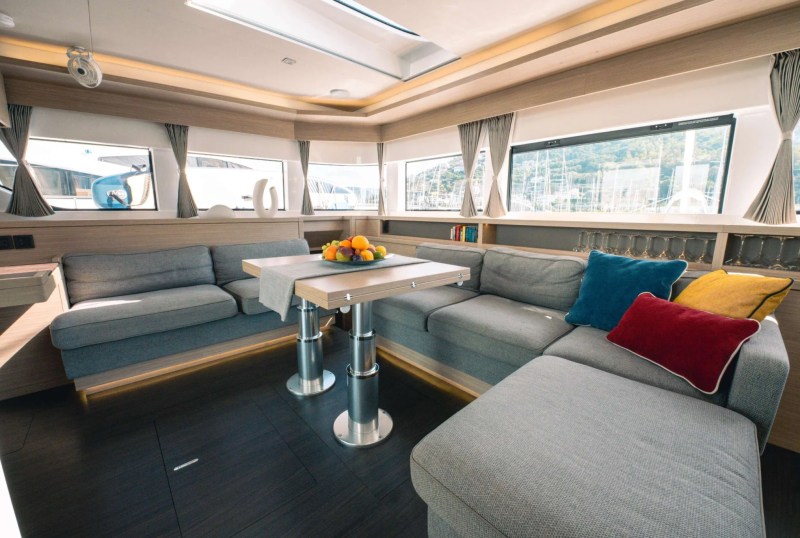
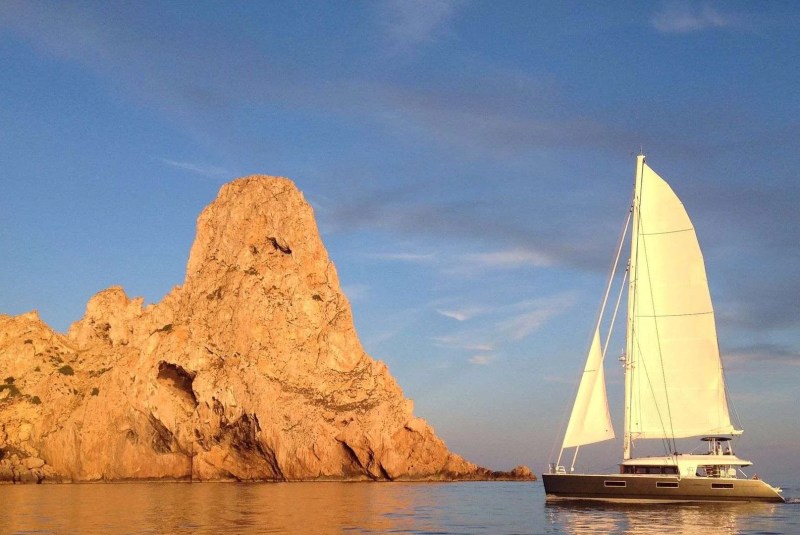
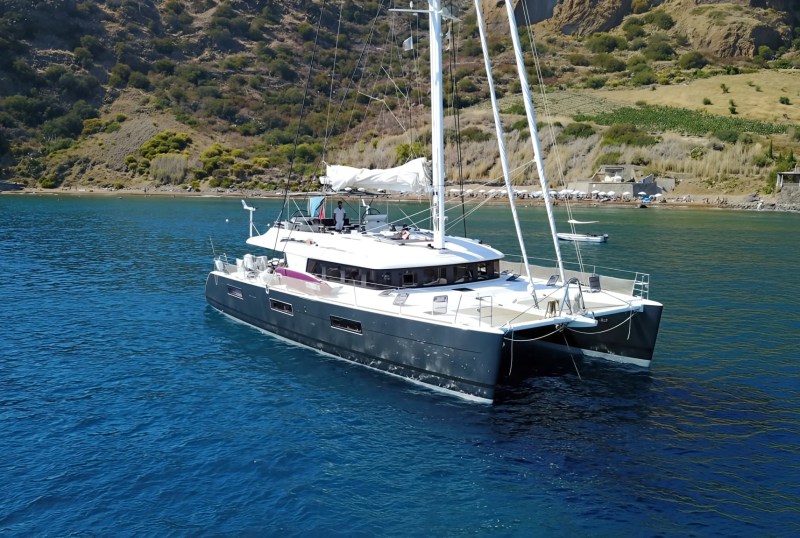
Catamarans exist here but are scarce and go early, so they are not the budget lever they are in Greece or the Caribbean.
On top of the weekly rate you pay an advance provisioning allowance of roughly 25 to 35 per cent, Italian VAT at 22 per cent and a crew gratuity of usually 5 to 15 per cent. Our Italy charter cost guide breaks every line down, with separate guides to how APA works and Italian charter VAT.
What moves the number on a Capri week is berths and pace. Our guide to why an Amalfi charter costs more than you expect is blunt about it: prestige stops, scarce summer berths and the wish to do the route properly all pull upward.
A week that anchors more and docks less, in June or September rather than August, is a materially different invoice for the same coastline.
Fitting Capri into the week
Capri is a day and a night, not a week, and everything around it is close.
| From | Distance | At 12 knots |
| Naples | 17 nm | 1 h 20 |
| Sorrento | 7 nm | 35 min |
| Nerano / Marina del Cantone | 5 nm | 25 min |
| Positano | 12 nm | 1 h |
| Amalfi | 17 nm | 1 h 25 |
| Ischia | 18 nm | 1 h 30 |
Naples is the usual start port and Sorrento the shortest hop on the coast. Nerano is the quiet anchorage our itinerary uses the night after Capri, and Ischia is the softer night after a loud day.
Our Naples round trip covers 96 nautical miles in seven days, which is the point of this coast: short legs, big impact. If you are deciding where to board, our guide to starting an Italy charter and how long the week should be cover it.
When to go
- June and September are what we recommend for a first Capri week: the same water as high summer with far fewer boats and better rates.
- July and August are the buzz, the beach clubs and the social week. The island is busy with yachts and with land travellers, marina space is tight, and berth planning matters more than anywhere else on the route.
- May and early October are quiet and beautiful, with a higher chance that the Blue Grotto is shut by swell and some beach clubs not yet open.
If the brief is privacy, read our guide to Italy without the crowds first: Capri can still work, early in the day and planned as one moment rather than the centre of every day. Our full month-by-month view is in the best time for an Italy charter.
Day charter to Capri, or the whole week?
There are plenty of day boats to Capri out of Sorrento, Positano and Naples, and for a couple with one free day they are the right answer. They are not the same thing as this page.
A day boat gives you four or five hours inside the same window every other day boat is working in.
A crewed week gives you the early grotto attempt, the empty lap of the island, lunch at anchor, the evening after the ferries leave, and a bed on board. It also gives you Procida, Ischia, Nerano and Positano around it.
If the week is the question we would always put you on seven nights, or six at the shortest. Anything less is a taster rather than a holiday, and Capri is the stop that proves it.
People also ask about Capri
Is Capri worth visiting on a yacht charter?
Yes, and it is better by yacht than any other way. Capri is not a sandy-beach island, so most of the best water time is from the yacht rather than from a beach; the Faraglioni and the sea caves are only properly seen from the water, and a yacht lets you arrive before the day boats and stay after they leave. What it is not is a place to spend the whole week.
How long does it take to get to Capri by boat?
About half an hour from Sorrento, an hour from Positano, an hour and a half from Amalfi or Ischia, and an hour to an hour and twenty from Naples depending on the yacht. All of them are short enough to do before lunch.
Where do yachts dock or anchor at Capri?
Marina Grande on the north side, roughly 300 berths at 2 to 8 metres, is the port, and it is one of the most competitive berths in Italy in summer. The alternative is at anchor off Marina Piccola on the south side with the tender ashore, which is how many crews do it. The other bays are rocky and poorly sheltered, so they are day stops.
Can you visit the Blue Grotto on a yacht charter?
Often, not always. The entrance is barely a metre high, so any swell closes it, and the visit itself is by small rowboat with queues on calm mornings. We plan it early in the day and treat it as an attempt: make the cave a stop, not the whole plan.
How much does a yacht charter to Capri cost?
A crewed week on this coast starts around €80,000 for a motor yacht and most of our Amalfi and Capri bookings sit between €150,000 and €300,000, plus APA of 25 to 35 per cent, 22 per cent Italian VAT and a 5 to 15 per cent gratuity. Berth choices and the time of year move it more than the island itself does.
Which is nicer, Positano or Capri?
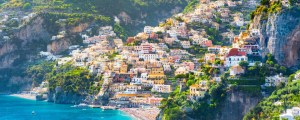
They answer different briefs. Positano is the view and the town, a cliff of houses you look at from the water and climb into for dinner. Capri is the swimming, the caves and the glamour, with a busier middle of the day. On a week you do both, and most of our routes put Capri first and Positano later.







 iMessage
 WhatsApp